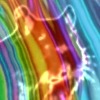
how in the hell do you create that drawing in and out motion? is that just another effect you set values for in Blender? cuz.... there's no way you're manipulating the image frame by frame like i have to. hehehe.
he he, if your referring to the change in perspective of the objects, it's mainly due to the blender rendering camera, moving around inside a virtual 3d space, and recording it's viewpoint over the course of the animation.
the only manipulating of frames in the context you work in, is from the post render/compositing tricks that shift pixels around a little from frame to frame, usually to enhance the wave type distortions, or add more color cycling and other effects.
and although a traditional 2d animator, like someone who works on a disney cartoon, could draw/paint each frame to achieve the same perspective tricks, it would be a lot more work, and probably be less fluid.
here's a few links to my yt videos that might help explain how this is achieved:
this first one shows the wire frame model of one of my backgrounds, which is close to how i work on it in the blender 3d editors.
and this video shows a similar background, in blender's 3d editors, with an (editing) camera filming the (rendering) camera from the side, represented by the little orange/yellow icon moving around inside the background model.
the yellow line is the rendering camera's line of sight, and it can only film what is between itself and the end of the line, anything beyond that distance, which is a parameter we can type into blender, will be invisible to the camera.
we can also set the focal length/field of view to limit what the camera can see off to it's sides.
the default focal length in blender is 35 mm which corresponds to the common wide angle lenses used in real life. i set the rendering camera in these animations to 8 mm which is equivalent to a fisheye lens, thus creating more of a perspective distortion.
the little white/black circles with crosses in them, moving around inside the background, are it's deformation bones, this is similar tech used for animating video game models, and they are invisible to the rendering camera in blender.
wow. lots and lots of really interesting and cool stuffs. Thanks so much, my friend. Re: demystification of your workflow: Yes it does in mant respects... but there are, of course, many things still flying over my head that I will ask you about if you don't mind. That whole working in 3-d and building models it really intense. Thanks again for the art tech-support. You are a fountain of digital art information, my friend. cheers. > This is a link sent to me from someone that featured some of my art... check it out of you get bored.: [link] its a psychology art thing... i found it to be twisted and bizarre yet somehow still intellectually stimulating hehehe.
he he, your very welcome smooothe, and i like the "fountain of digital art information" very nice analogy.
that feature is very cool. this one [link] in particular by mechanicalhemiola is using an effect i'm planning on using for some of my future videos, although i haven't yet decided which method i'll use. and i probably won't use a human head as a base for the particles, as cool looking as that is, i think mine will be more abstract.
and although there are several technical ways of achieving this, it basically means we can attach tiny objects to the surface, or moving around inside, a hull type object. and that hull could be anything from a rigid coffee cup, to a swirly, organic, morphing shape like my background models.
and to add to the mind fuck, the tiny (child) objects can even be replicas of the (parent) hull object.